
Iodine is an indispensable component in the biosynthesis of the thyroid hormones thyroxine (T4, prohormone) and triiodothyronine (T3, active hormone).1 Iodine must be obtained through the diet, as the body is unable to produce it. The risks posed by iodine deficiency are well recognized, but more widespread use of biomarkers for iodine status has demonstrated that iodine deficiency is still evident within subpopulations in high income countries, including areas with low goiter prevalence, and even in regions where iodine deficiency was considered eradicated. 2
It is likely that multiple factors contribute to the re-emergence of iodine deficiency in industrialized nations. These factors potentially include the impact of public health messaging about salt reduction with regard to hypertension and cardiovascular disease; prevalence of vegan and dairy-free vegetarian diets; use of natural sea salts and salt alternatives; and changes in agricultural practices, such as the decreased use of iodine-enriched fertilizers.3,4
In addition to its role in the biosynthesis of thyroid hormones, iodine is a powerful scavenger of reactive oxygen species (ROS). Furthermore, via interaction with different tissue-specific peroxidases throughout the body, iodine has been shown to have strong antimicrobial and antifungal activity, as well as antineoplastic effects in human cancer cell lines.5
Common Concerns About Iodine Excess
A healthy adult human has about 15-20 mg of iodine in their body, 70-80% of which is in the thyroid gland. The response of the thyroid to excess iodine intake can vary, in large part depending on the undiagnosed presence of underlying thyroid disease. In euthyroid individuals, the thyroid gland has compensatory homeostatic mechanisms, known as the Wolff-Chaikoff effect, that prevent excess production of thyroid hormone following an iodine load, with the thyroid gland readjusting within days or weeks. However, in some individuals, iodine excess can lead to subclinical or overt thyroid dysfunction, depending on underlying thyroid health, and result, most typically, in hyperthyroidism. Less commonly, iodine excess can lead to hypothyroidism, usually in patients with a history of thyroid disease or exposure to high iodine concentrations from, for example, iodinated contrast media used in radiologic studies.6,7
Several studies have shown that supplementing with iodine at moderately high concentrations is well tolerated in euthyroid individuals. Only high doses (defined as greater than 30 mg/day), are associated with hypothyroidism and goiter, both of which rapidly normalize once administration of high doses is stopped 8,9,10
Even in people who have an underlying thyroid issue (such as autoimmune thyroiditis; postpartum or subacute thyroiditis; prior treatment with radioactive iodine; subtotal thyroidectomy; or history of external thyroid irradiation), or who are taking certain medications (for example, lithium, which interferes with the formation of thyroid hormone precursors), it has been shown that excessive iodine intake may lead to overt or subclinical hypothyroidism, but it is transient and resolves when iodine intake is decreased.11 In a Swedish study of over 2000 pregnant women in a mild-to-moderate iodine-deficient population, an optimal iodine supplementation was associated with the lowest risk for thyroid autoantibody positivity.12
δ-iodolactone: Protecting the Thyroid from Free Radical Damage
The significant role of free radicals in triggering or worsening thyroid autoimmunity is now widely acknowledged.13 Low dietary iodine can impair the synthesis of δ‑iodolactone, a crucial iodinated lipid that regulates thyroid follicular growth and inhibits the production of free radicals, including the reactive oxygen species (ROS), H2O2.
An insufficiency of δ‑iodolactone may help explain why both iodine deficiency and iodine excess are, paradoxically, associated with triggering or exacerbating autoimmune thyroiditis, given the role δ‑iodolactone has in protecting the thyroid from oxidative damage and in cell-cycle regulation.14
δ-iodolactone is undetectable in human tissue in the presence of iodine deficiency but becomes detectable with iodine administration at levels 100x the RDA.15,16
The Importance of Selenium and Zinc
Reports of transient increases in thyroid antibodies with iodine supplementation mean it’s essential that clinicians ensure their patients take iodine in combination with protective cofactors. For example, the iodothyronine deiodinase enzymes (which convert T4 to T3) and glutathione peroxidase enzymes (which protect the thyroid from hydrogen peroxide-induced damage during thyroid hormone synthesis) all require selenium.17,18 Selenium works synergistically to influence iodine homeostasis, metabolism, and bioavailability. Selenium deficiency is likely responsible for some of the adverse effects seen with iodine deficiency.19
Research also shows that zinc has a crucial role in thyroid hormone metabolism. Specifically, zinc regulates the activity of deiodinases enzymes and the synthesis of thyrotropin releasing hormone (TRH) and thyroid stimulating hormone (TSH). In addition, it modulates the structure of transcription factors that are essential to thyroid hormone production.20
Clinician Workflow for Iodine Support
The following protocol is commonly administered by several highly experienced physicians in their clinical practices:
- Establish patient baseline measures using these lab tests: TSH, FT4, FT3, TPOAb, TgAb, and spot UIC (urinary iodine concentration).
- Provide Dietary counselling: Recommend iodized salt, sea foods, and dairy. Limit bromide‑rich processed foods. Bromide acts as an iodide antagonist in the body and inhibits the absorption of iodide via the NIS (sodium/iodide mediated transport symporter), which facilitates active transport of iodide into thyroid cells for thyroid hormone synthesis.
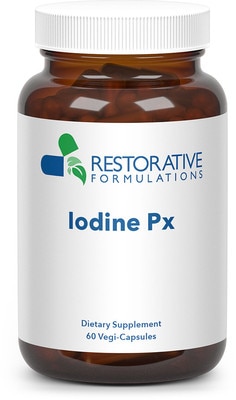
- If UIC <300 µg/L, then supplement with 6-25 mg iodine plus 200 µg selenium. Re-test in eight weeks. This UIC level is based on published studies of 24-hour urine collection data from healthy Japanese adults whose diet consists of significant sources of iodine. These studies estimate median iodine excretion in this population to be about 365 µg/day.21
- Monitor for transient antibody bump; consider antioxidant support (vitamin C, NAC)
- For advanced iodine support, use the iodine-loading test (50 mg dose, 24-hour urinary excretion) to assess whole-body saturation, as described in Dr. Guy Abraham’s protocol.
References
- https://pubmed.ncbi.nlm.nih.gov/20172467/
- https://lpi.oregonstate.edu/mic/minerals/iodine#deficiency-risk accessed July 25, 2025
- https://pubmed.ncbi.nlm.nih.gov/36079737/
- https://pmc.ncbi.nlm.nih.gov/articles/PMC9182735
- https://pmc.ncbi.nlm.nih.gov/articles/PMC8709459/
- https://pmc.ncbi.nlm.nih.gov/articles/PMC10284623
- https://pmc.ncbi.nlm.nih.gov/articles/PMC9182735
- https://pmc.ncbi.nlm.nih.gov/articles/PMC7865438/
- https://pubmed.ncbi.nlm.nih.gov/30891786/
- https://pubmed.ncbi.nlm.nih.gov/20172475/
- https://pubmed.ncbi.nlm.nih.gov/11396709/
- https://pubmed.ncbi.nlm.nih.gov/31524090/
- https://pubmed.ncbi.nlm.nih.gov/32969631/
- https://pmc.ncbi.nlm.nih.gov/articles/PMC8106604/
- https://pubmed.ncbi.nlm.nih.gov/7788015/
- https://pubmed.ncbi.nlm.nih.gov/8767514/
- https://pubmed.ncbi.nlm.nih.gov/16223863/
- https://pubmed.ncbi.nlm.nih.gov/22009156/
- https://pubmed.ncbi.nlm.nih.gov/20172476/
- https://pmc.ncbi.nlm.nih.gov/articles/PMC10499380/
- https://www.jstage.jst.go.jp/article/endocrj/69/4/69_EJ21-0486/_article/-char/ja/